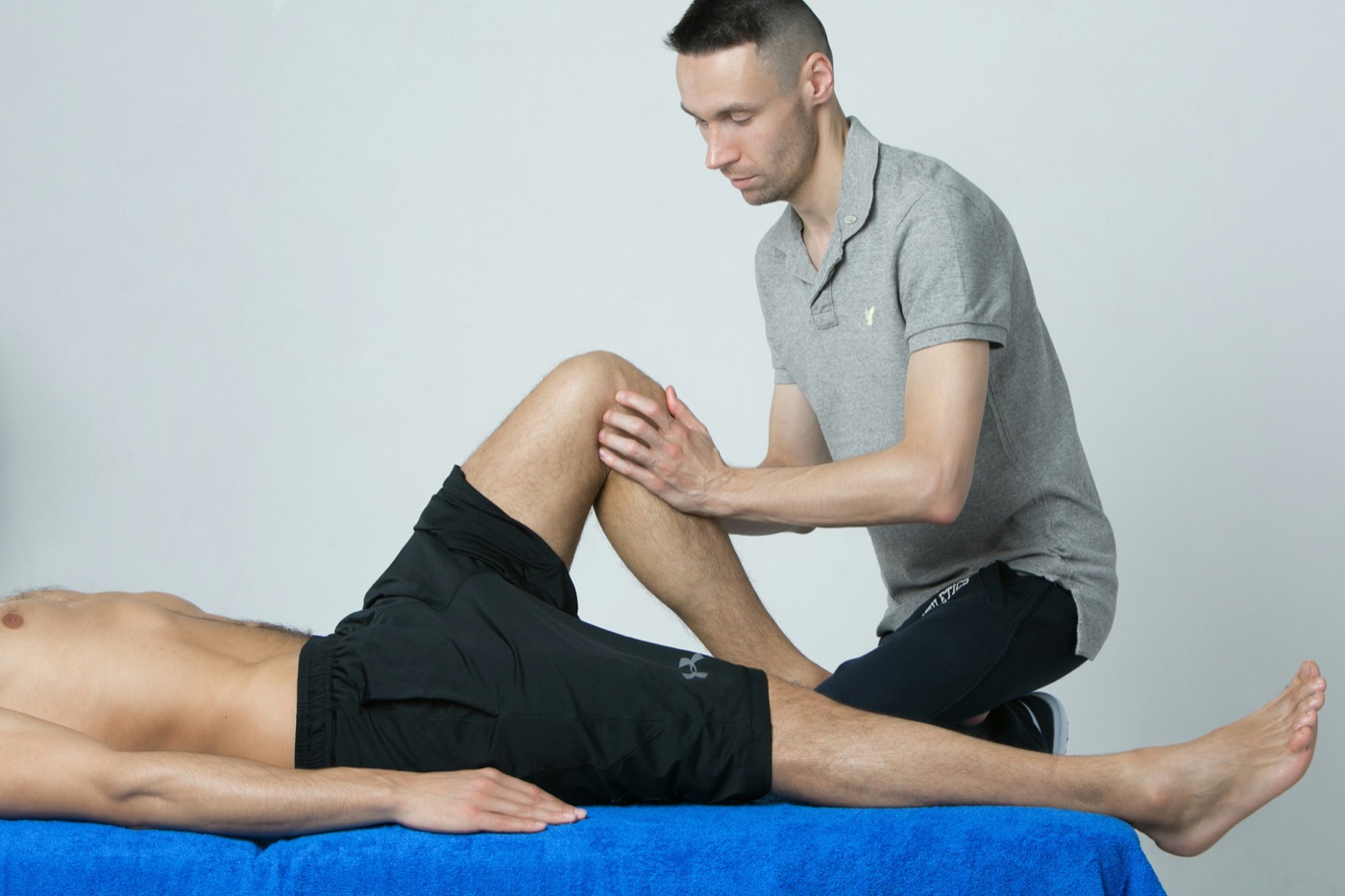
Assisted stretching is a therapist-guided session that uses proprioceptive neuromuscular facilitation (PNF) to access range of motion you can't reach alone. Because a therapist works with your nervous system's protective reflexes and stabilizes the joints around the target muscle, it produces faster, longer-lasting flexibility gains than static stretching at home.
If you've been stretching on your own for years — hamstring stretches before a run, shoulder rolls at your desk, maybe the occasional yoga class — and you're still tight, still uncomfortable, still limited in how far you can reach or turn, you're not failing at stretching. You're just doing the version that doesn't work very well for chronic tightness.
Assisted stretching is something different. It's one of the fastest-growing services in wellness right now, and there's a reason for that: it works, and it works faster than anything you can do solo.
What Is Assisted Stretching, Exactly?
At its core, assisted stretching is a therapist-guided, hands-on session where a licensed professional takes your body through movements you can't safely or effectively do alone. But that's the simple version.
The real mechanism involves a technique called proprioceptive neuromuscular facilitation (PNF) — a method that leverages your nervous system's natural responses to dramatically increase your range of motion. Here's how it works:
- Your therapist moves your limb toward the end of its range
- They ask you to gently resist (contract the muscle being stretched)
- You hold that contraction for a few seconds, then release
- On the release, your nervous system temporarily reduces its protective braking on that muscle
- Your therapist takes advantage of that window to move you further than your muscle would normally allow
Over time, and with repetition, your nervous system learns to accept this new range as normal. The change becomes structural, not just temporary.
Why Can't You Replicate This at Home?
Static stretching — holding a stretch for 30 seconds, which is what most of us do — has its place. It helps maintain range of motion you already have. But it doesn't effectively increase range of motion in chronically restricted areas, and it doesn't engage the neurological mechanisms that PNF does.
The other challenge with solo stretching is that you can't properly stabilize your own body. When you try to stretch your hip flexor, for example, your lower back often compensates. When you try to stretch your hamstrings, your pelvis tilts. A therapist can isolate the target muscle by stabilizing the joints around it — something you simply cannot do to yourself.
"Your body has protective reflexes that limit how far you can stretch yourself. A trained therapist knows how to work with those reflexes rather than against them. That's why the results are so different."
— Luke Stokes, LMT, Founder of Dawn Wellness
What Does a Session Look Like With Luke?
Luke Stokes, the founder of Dawn Wellness, has built his entire practice around the combination of assisted stretching and therapeutic massage. Most of his long-term clients come to him specifically for assisted stretching, and most of them started because they'd tried everything else.
A typical assisted stretching session at Dawn Wellness (mobile, so he comes to you) goes like this:
- Assessment: Luke evaluates your current range of motion, identifies the areas of greatest restriction, and asks about your goals and history.
- Targeted work: He works systematically through your key areas, using PNF and passive stretching techniques, always communicating about what you're feeling.
- Integration: At the end, he'll often have you move through a few active movements to reinforce the new range your nervous system just learned.
- Homework (optional): For clients doing a treatment plan, Luke may give you one or two things to work on between sessions to support the progress.
Who Benefits Most From Assisted Stretching?
Almost everyone benefits — but some people see especially dramatic results:
- Athletes with chronic tightness (hip flexors, hamstrings, thoracic rotation)
- Office workers with upper back, neck, and shoulder restrictions from years of desk posture
- People in their 30s–50s who've noticed their flexibility declining and want to reverse it
- Post-physical therapy clients who've graduated from PT but still have mobility deficits
- Anyone who's tried yoga and found they couldn't get deep enough to feel a real stretch
How Many Sessions Does It Take?
Most people feel a meaningful difference after their first session — more range of motion, less tension, sometimes the absence of a chronic ache they'd stopped noticing because it was so constant. But that's one session.
Real, lasting change happens over multiple sessions. Luke typically recommends starting with 3–5 sessions close together (once or twice a week), then assessing progress and adjusting the cadence from there. The body needs repeated input to learn and accept new movement patterns. One session gives you a preview. A plan gives you results.
In the Tampa Bay area, Dawn Wellness serves clients across St. Petersburg, Clearwater, Tampa, the Pinellas beaches, Dunedin, Safety Harbor, and beyond — all mobile, all at your location.
The Bottom Line
If you're chronically tight and static stretching hasn't fixed it, assisted stretching is worth trying. The mechanism is different, the outcomes are different, and the experience — when you're working with a skilled therapist — is entirely different from rolling out a yoga mat by yourself.
The best way to start is with a free 15-minute phone consult. Tell Luke what's going on with your body. He'll tell you whether assisted stretching is the right first step.
Frequently Asked Questions
What is assisted stretching?
Assisted stretching is a therapist-guided, hands-on stretching session where a licensed professional moves your body through ranges of motion you can't safely or effectively reach on your own. It commonly uses proprioceptive neuromuscular facilitation (PNF), which engages your nervous system's reflexes to increase range of motion faster than static stretching.
How is assisted stretching different from stretching at home?
When you stretch alone, a protective reflex limits how far you can go, and you can't stabilize the surrounding joints to isolate the target muscle. A therapist stabilizes those joints and uses PNF to work with your reflexes rather than against them, producing larger, longer-lasting gains than static stretching.
How many assisted stretching sessions does it take to see results?
Most people feel more range of motion and less tension after a single session, but that initial change is largely neurological and fades over a few days. Lasting, structural change typically comes from 3 to 5 sessions close together, then a maintenance cadence based on your goals.
Who benefits most from assisted stretching?
Athletes with chronic tightness, office workers with neck and shoulder restrictions, people in their 30s to 50s noticing declining flexibility, post-physical-therapy clients with lingering mobility deficits, and anyone who has stretched consistently on their own but still hit a wall.